Empowering Your Digital Future
with Confidence
Written by Jeff Poissant, RGD
Updated August 2026
In today’s hyper-connected world, cybersecurity is no longer optional—it is a core business and public-service imperative. From small businesses and professional practices in Ottawa to non-profits in Kingston and municipal agencies in Belleville and across Eastern Ontario, organizations of every size face persistent, evolving threats. Canada’s National Cyber Security Strategy (announced February 2025) and the Canadian Centre for Cyber Security’s assessments make the stakes clear: proactive defence is essential to protect sensitive data, maintain operational continuity, and preserve the trust of clients, donors, residents, and partners.
At EvolvingMedia.com I combine secure, 100% Canadian B2B web hosting with thoughtful content development so your digital presence is both resilient and compelling. My Canadian-hosted solutions keep your data in Canada (supporting PIPEDA compliance) while delivering the performance and reliability your audiences expect.
- Average cost of a data breach in Canada: CA$6.98 million (IBM Cost of a Data Breach Report 2025)
- Record CA$704 million in reported fraud losses to Canadians in 2025 (Canadian Anti-Fraud Centre)
- Ransomware remains the top cybercrime threat to critical infrastructure and is opportunistic against organizations of all sizes
Source: Canadian Centre for Cyber Security, National Cyber Threat Assessment 2025-2026 and Ransomware Threat Outlook 2025-2027. Regional Eastern Ontario business-specific quantitative data is limited in public reporting; national trends apply across the region.
The Current Canadian Threat Landscape
The National Cyber Threat Assessment 2025-2026 from the Canadian Centre for Cyber Security paints a clear picture: cybercrime remains widespread and disruptive, and ransomware is the top cybercrime threat facing Canada’s critical infrastructure. State-sponsored actors (particularly those linked to the People’s Republic of China) have grown more aggressive, moving beyond pure espionage toward disruptive effects. At the same time, a thriving Cybercrime-as-a-Service ecosystem lowers the barrier for opportunistic, financially motivated criminals.
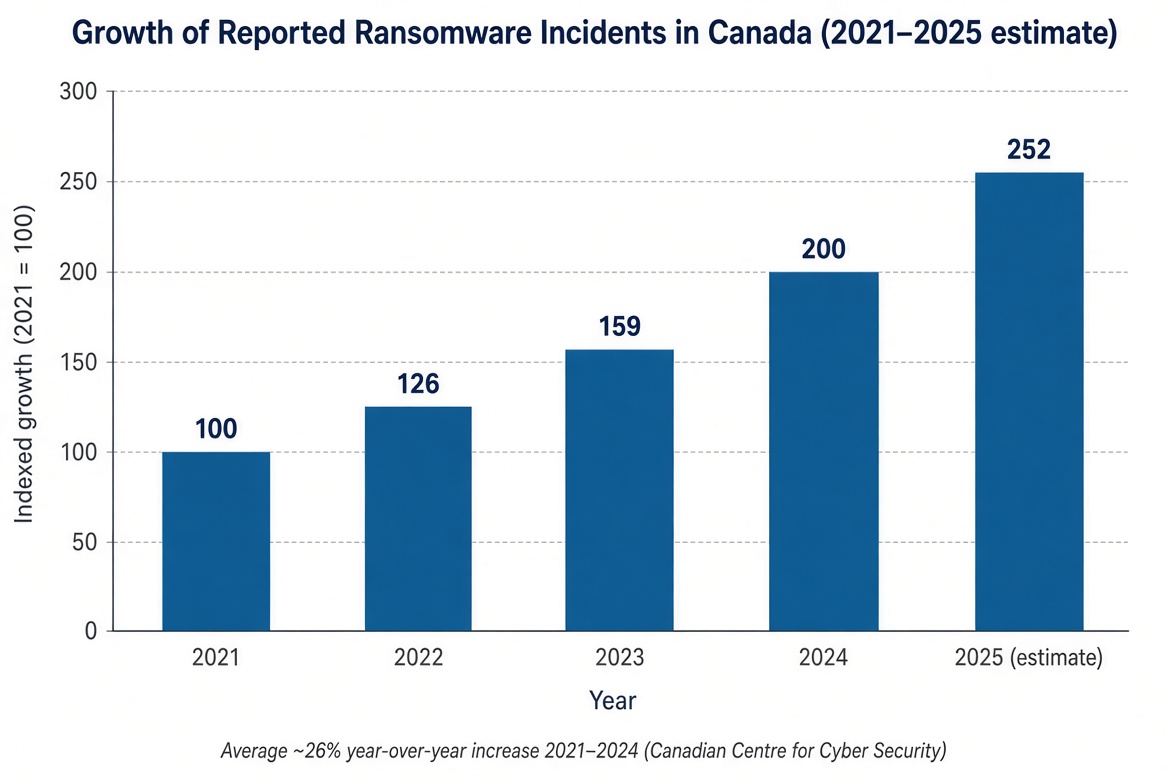
The more recent Ransomware Threat Outlook 2025 to 2027 (released January 2026) confirms the trajectory: the ransomware threat continues to increase and evolve. Actors are leveraging artificial intelligence, refining double- and multi-extortion tactics, and remaining highly opportunistic. All Canadian organizations—regardless of size or sector—face real risk. Incidents reported to the Cyber Centre showed an average year-over-year rise of roughly 26% from 2021 to 2024, and the outlook for the next two years remains elevated. Basic cyber hygiene (timely updates, multi-factor authentication, tested backups, and phishing vigilance) continues to be among the most effective defences.
These national trends have local impact. Small and medium-sized businesses, non-profits with limited IT resources, and municipal or public-health organizations are frequent targets precisely because they hold valuable data yet often lack enterprise-grade defences. Average costs of a Canadian data breach have climbed, and successful phishing or business-email-compromise incidents can produce immediate financial losses that are difficult to recover.
Lessons from Eastern Ontario and Beyond
Eastern Ontario has already seen the consequences. In 2021 the City of Clarence-Rockland suffered a significant cyber incident that disrupted municipal systems for weeks, affecting email, payment processing, and day-to-day operations. Around the same time, Kemptville District Hospital experienced a cybersecurity incident that forced temporary closure of its emergency department and suspension of some outpatient services while systems were secured. More recent Canadian examples include ransomware claims against municipalities (such as Oxford County in 2025), public-health units, and a growing number of small-business and non-profit victims. Phishing and credential-theft campaigns continue to cause direct financial losses—even for business improvement associations and similar community organizations.
These incidents illustrate a consistent pattern: downtime, recovery costs, reputational harm, and eroded public or donor trust. Non-profits risk losing supporter confidence; municipalities face service interruptions and scrutiny; small businesses can confront existential financial pressure.
Building Practical Resilience
The good news is that many high-impact risks can be reduced with disciplined, layered practices aligned with guidance from the Canadian Centre for Cyber Security and Canada’s National Cyber Security Strategy:
- Enforce multi-factor authentication (MFA) everywhere possible, especially for email, remote access, and administrative accounts.
- Keep software, plugins, and operating systems updated; unpatched systems remain a primary entry point.
- Maintain offline or immutable backups and test restoration regularly—backups are often the difference between a recoverable incident and a crisis.
- Train staff to recognize phishing, business-email compromise, and social-engineering attempts; these remain the most common initial vectors.
- Choose hosting and service providers that keep data in Canada, apply robust security controls (firewalls, malware scanning, regular backups), and offer responsive support.
- Develop and practise an incident-response plan so the organization can contain, communicate, and recover efficiently.
Canada’s 2025 National Cyber Security Strategy emphasizes whole-of-society engagement and agile, collaborative action. Individual organizations that adopt these fundamentals contribute directly to collective resilience.
How I Support Your Security and Success
Hosting on Secure Canadian Managed Virtual Private Servers forms the foundation. My solutions are designed for businesses, non-profits, and public-sector clients who need reliability, data residency in Canada, and practical security features without enterprise complexity. Combined with my content and design services, I help you present a professional, trustworthy digital presence that reinforces the confidence you are building offline.
The Evolving Media Chronicles series continues to deliver actionable, real-world insights—covering topics from password hygiene and email spoofing to broader risk-mitigation strategies—so you stay informed as the threat landscape shifts.
If you’re ready to strengthen both the technical foundation and the public face of your digital presence, I’d be happy to talk. Explore the Canadian hosting options, content services, and the full Chronicles archive. In an environment where threats continue to evolve, proactive steps taken today protect the trust and continuity your organization depends on tomorrow.
Sources & Further Reading
Official Canadian Government & Cyber Centre Publications
- Canadian Centre for Cyber Security. National Cyber Threat Assessment 2025-2026. Released October 2024.
https://cyber.gc.ca/en/guidance/national-cyber-threat-assessment-2025-2026 - Canadian Centre for Cyber Security. Ransomware Threat Outlook 2025 to 2027. Released January 2026.
https://www.cyber.gc.ca/en/guidance/ransomware-threat-outlook-2025-2027 - Public Safety Canada. Canada’s New National Cyber Security Strategy. Announced 6 February 2025.
https://www.canada.ca/en/public-safety-canada/news/2025/02/canadas-new-national-cyber-security-strategy.html
(Backgrounder and related materials also available on Canada.ca) - Communications Security Establishment Canada. Communications Security Establishment Canada Annual Report 2025-2026.
https://www.cse-cst.gc.ca/en/accountability/transparency/reports/communications-security-establishment-canada-annual-report-2025-2026
Documented Eastern Ontario / Canadian Incidents Referenced
- City of Clarence-Rockland cyber incident (October 2021) – reported by CBC News and local coverage (The Review). Systems disruption confirmed by municipal statements.
- Kemptville District Hospital cybersecurity incident (October 2021) – reported by Global News, Ottawa Citizen, and CBC; emergency department temporarily closed.
Additional Context on Scale of Impact (2025–2026)
- Canadian Anti-Fraud Centre statistics (2025 losses) and IBM Cost of a Data Breach Report (Canadian figures) as cited in independent 2026 analyses of Canadian SMB cyber risk.
- Ongoing municipal and public-sector ransomware activity tracked by the Canadian Centre for Cyber Security and open-source incident monitoring (e.g., Oxford County 2025, Lakelands Public Health early 2026).
All threat assessments and strategy documents above are primary sources published by the Government of Canada or the Canadian Centre for Cyber Security (part of CSE). They form the factual backbone of the article’s national threat overview and recommendations.